

Our Commitments
Our Policies
At RIMCO, we adhere to the following commitments.
- 01 No use of child labour
- 02 Workplace equality
- 03 Respect of universal human rights through prohibiting violence, forced labour, and slavery
- 04 Health and safety at work (OHS)
- 05 Provide at least a legal wage and work to achieve living wage
- 06 Engage positive impact in the communities surrounding operations and the supply chain
- 07 Engage supply chain due diligence through the CRAFT system implementation
- 08 Respect for the environment and cultural heritage
- 09 Combat corruption, bribery, and conflicts of interest
- 10 Freedom of association and protection for whistleblowers
GLOBAL WORKPLACE STANDARD (GWS)
Our processing centers operate in progressive alignment with the Responsible Mica Initiative (RMI) Global Workplace Standard (GWS) . Processes and facilities are tailored to meet the 419 criterias of the standard, which are structured into five core pillars:

Our Annual ESG Report provides a transparent account of our progress against these criteria, while independent third-party audits validate our compliance and performance scoring.
- Amboasary Atsimo : Audit result 2025 : 57%
- Antsirabe processing center : Audit scheduled on January 2026
MICA CRAFT : SECURING THE SOURCE
Mica CRAFT Code is an international framework which ensures small-scale mining groups transition from informal practices to responsible, transparent trade through five strategic modules:
RIMCO has structured its Craft system around two distinct AMPs (Artisanal and Small-scale Mining Producers) :
- AMP 1: Comprises pilot mines in the Matsiatra-Ambony, Ihorombe and Anosy regions, supplying mica to the Antsirabe processing center.
- AMP 2: Comprises pilot mines in the Anosy and Androy regions, supplying mica to the Amboasary Atsimo processing center.
Dedicated team (supervisors and focal point) are appointed within both AMPs, to be a part of CRAFT Committee, which is responsible for risk assessments, mica flow traceability, and conducting training and awareness-raising sessions to fulfill every CRAFT criterion.
Starting in 2027, a CRAFT Report will be published annually to monitor progress. Following the initial implementation and 3 years transition period, official audits are scheduled to take place in 2029, unless our downstream partners request an interim audit.
Craft Report
INCOME MONITORING
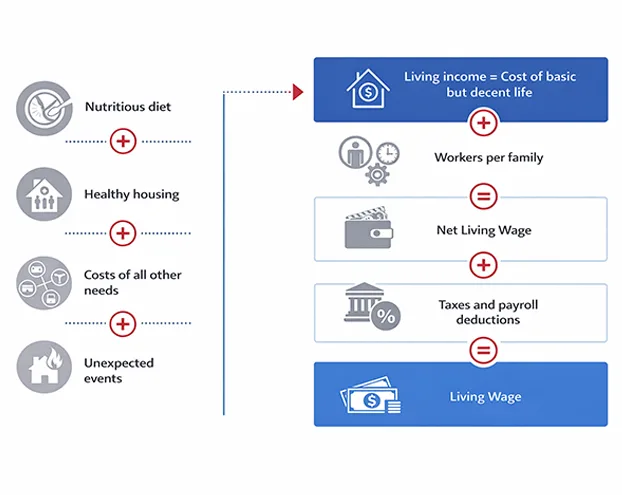
Achieving a Living Income is a core pillar of responsible mining. However, this transformative goal cannot be reached by RIMCO's efforts alone; it requires the active cooperation of our downstream partners, particularly regarding mica pricing. To empower data-driven decisions, we monitor all wages and archive payment proofs for miners and processing workers.
We categorize all worker and miner earnings through a precise hourly monitoring system. Each monthly report classifies wages into three performance tiers:
- Legal Wage Matched
- Living Wage Matched
- Mismatched
These results are available in real time through our secure Customer Portal, integrated with our traceability data. This transparency allows our partners to evaluate the true social impact of their sourcing and verify progress toward a sustainable Living Wage.
Our compliance system currently benchmarks against the national minimum wage of 300,000 Ar per month (as per Decree No. 2026-1352).
SOCIAL RESPONSIBILITY
RIMCO's CSR program is built on three pillars designed to address livelihood challenges and infrastructure needs, ensuring basic human rights for communities across our supply chain. Partnering with the NGO RIO, we address these issues through a commitment to shared value and beneficiary empowerment. We invite our supply chain partners, global institutions, and financial stakeholders to join us in funding these initiatives to maximize our reach and secure long-term development.
Childern's rights & eliminating child labor
Empowerment & living incomes
Infrastructure & care